

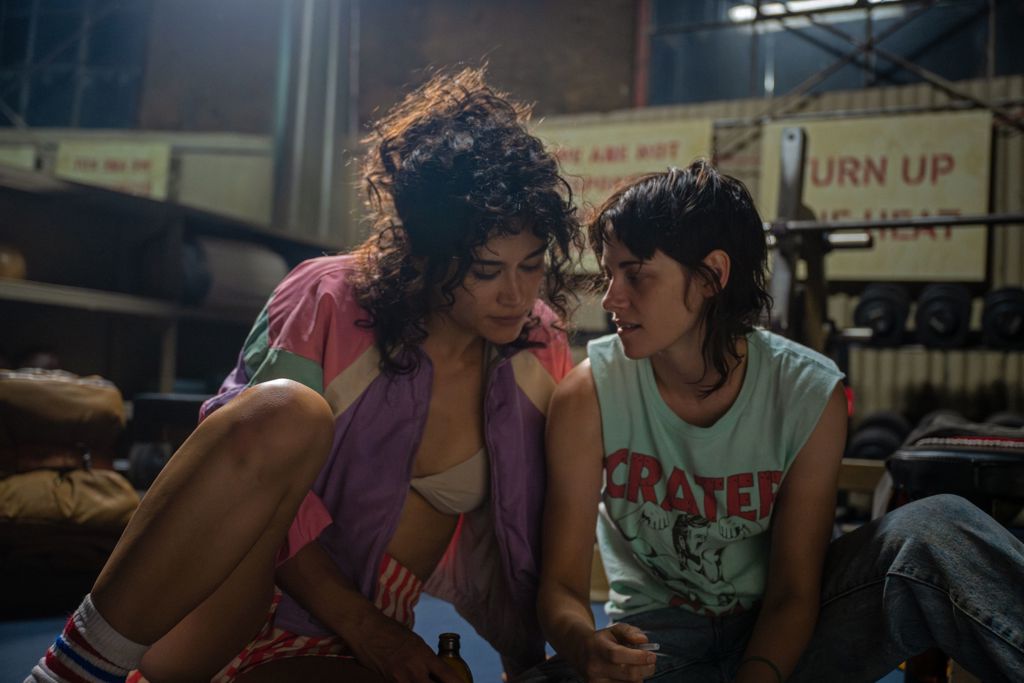
Director Rose Glass’ second feature, Love Lies Bleeding, is a film that pumps and pulses. This can be felt in composer Clint Mansell’s thrumming electro-synth score, or in the reps and bursting bodies of the anonymous gym-goers, who feature in a sweaty montage introducing Crater Gym, where Lou (Kristen Stewart) works as a manager. It’s in the swelling veins of drifter Jackie (breakout star Katy O’Brian), who blows through New Mexico on her way to a Las Vegas bodybuilding competition. Most of all, it’s in the throbbing pangs of desire shared between the two women, as Lou and Jackie meet, bond, and become embroiled in criminality in this 1980s-set neo-noir.
The film, co-written by Weronika Tofilska, is the follow-up to Glass’ horror debut, Saint Maud (2019). In the desert, Lou is first seen unclogging shit from a toilet. She’s estranged from her father, Lou Sr (Ed Harris), who runs a gun range in town (later hiring Jackie as a waitress) and is under scrutiny by the FBI. Lou remains in their sleepy town only to keep an eye on her sister Beth (a stellar Jena Malone), who’s trapped in an abusive marriage to a man named JJ (Dave Franco). Perpetually at the whim of other people’s impulses, Lou has made a life of tending to violent messes.
When she first sees Jackie, reflected in the mirrors of the gym, the attraction is immediate. She gazes at the brawny stranger with wordless need. Once acquainted, Lou offers Jackie some of the steroids that pass through the gym in sly deals. She injects her in the ass with a small dose, quite literally piercing the veil between them. I’m reminded of a 2019 essay by Quinn Latimer, titled ‘Muscle Beach,’ in which she describes bodybuilding as a means of transforming the normative body into an alien one: “…breaking it down, building it up. Pushing it past the limits of the known.” As a practice of strengthening via repetition, bodybuilding both expands the margins of the body and reinforces its constraints. The experience of desire, however, does something to these margins; the body seems to extend endlessly, becoming open and pliable. Wanting someone or something makes us ooze—but it also makes us more vulnerable to chaos.
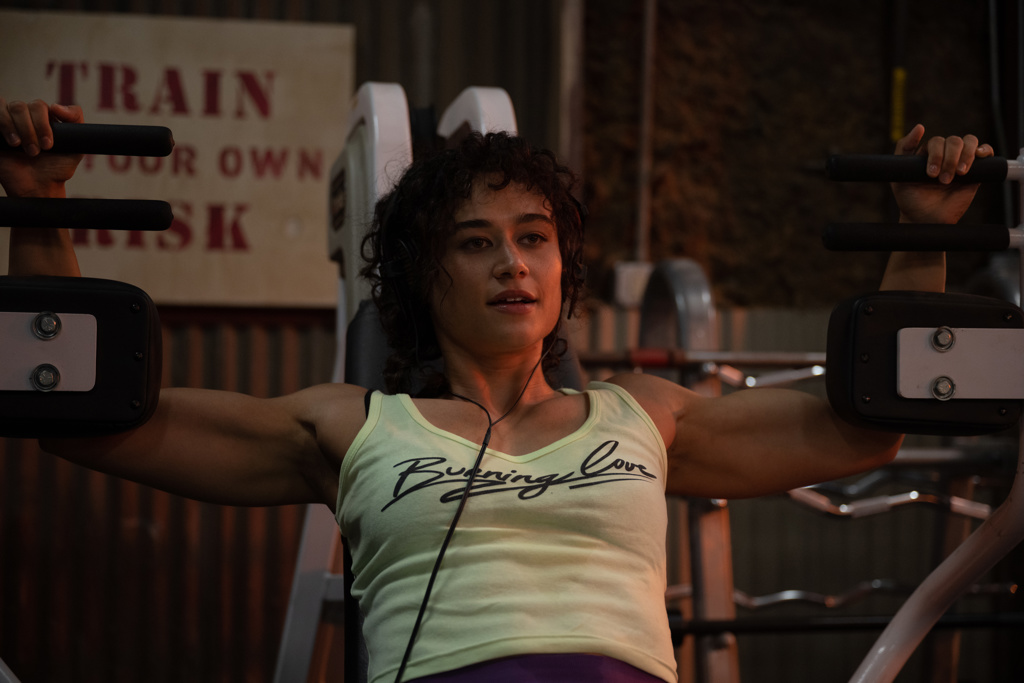
Lou and Jackie immediately have sex. The next morning, Lou cooks an omelette for Jackie, already at ease in her lover’s Crater Gym muscle tank. Both women feel, to a degree, trapped and aimless. As Lou, Stewart is naturally smaller, more tense and interior than Jackie, whose charm and showmanship O’Brian skilfully layers over a fragile core. In another of the film’s palpitating montages, we observe sexual frenzy, dripping protein shakes, workouts, and steroid injections on repeat. The women’s environs flaunt the irresistible filth of their relationship: cracked eggs to help Jackie bulk up, the cigarettes Lou keeps failing to quit.
Despite sequences of almost blissful eroticism, violence is portentously edited into the soundscape of Glass’ film, which dislodges familiar noises like rumbling thunder from their sources. A cut from one scene to another is marked by a gunshot. As Jackie grows increasingly addicted to steroids, close-ups of her popping muscles are scored by ripping foley. This disturbed reality is embodied, too, by the eerie theremin of Mansell’s music and the sight of cavernous desert landscapes against a vast, starry sky. The latter is courtesy of cinematographer Ben Fordesman, whose work here often recalls the poetic, dusty expanses of Dutch legend Robby Müller, collaborator on films by Wim Wenders, Jim Jarmusch, and Lars von Trier.
In a mix of memory and nightmarish fever, the film sometimes slips into red-hued visions of guns, or of a menacing Lou Sr (creepily styled with straggly blond hair), who we learn once enlisted his daughter in his firearm smuggling crime ring. While these sequences offer little more than vague intrigue, the red-light motif is striking. Reappearing at choice moments (the brake lights of a vehicle during a nerve-wracking drive, or the glow of a Coca-Cola machine in a hospital hallway), it creates a sensory thread that yokes together past and future indiscretions.
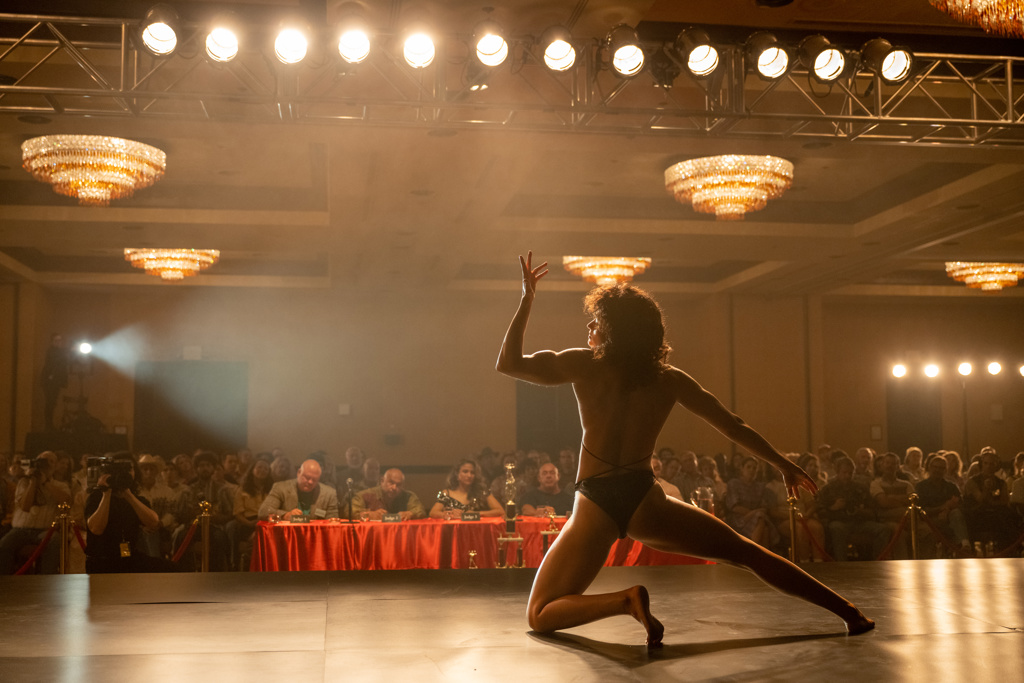
And, once the indiscretions begin, they accumulate quickly. JJ batters Beth so badly that she winds up unconscious in the hospital. Seeing Lou’s fury, Jackie avenges his cruelty, requiring the lovers to mitigate the damage by destroying evidence at the depths of a vast canyon. These actions threaten to lead authorities to Lou’s father, who catches wind of a plot against him. Jackie’s manic attempts to regain control, which mostly manifest as obsessive bodily discipline and roid rage, are comically counterpointed by trite ‘grindset’ slogans peppering the gym walls (“The body achieves what the mind believes”). Jackie hitchhikes to Las Vegas alone, where a vicious outburst plunges her and Lou deeper into Lou Sr’s crimes, pitting the women against each other.
As shown in Saint Maud, in which a devout young nurse tries obsessively to save her sick patient’s soul, Glass excels at conveying a character’s descent into hysteria; how she builds out from there (either by delivering on a terrifying climax or resolving a bloody, complicated mess) is more uneven. If the first half of Love Lies Bleeding sets up an exciting bundle of tensions, the final half of the film scrambles to satisfyingly unpick them. With Stewart and O’Brian apart, the film—missing their shared, charged energy—searches for its life force in more traditional crime plotting. There are intersecting games of manipulation, as well as the reappearance of an old flame of Lou’s, played by an energetic Anna Baryshnikov. These details keep the wheels turning, albeit with less flare, as the fraught father-daughter dynamic between Stewart and Harris intensifies. But some level of depth is missing—while much of the writing is pulpy and entertaining, the film rushes to establish a deeper sense of history long after the climax is underway.
Beyond the addictive, mania-inducing properties of desire, Love Lies Bleeding takes strength as its subject. Not just raw, muscular strength, but the strength it takes to survive a tormented relationship or stay in a backwater town for the sake of someone else; perhaps, the kind of strength that arrives, as if divinely sent, only when motivated by voracious love. It’s on this note that the film culminates in a gutsy, fantastical sequence that, depending on your tastes, will play as either silly or transcendent.
But one has the feeling that, despite this risk, Glass and Tofilska don’t totally know what the women mean to each other—let alone themselves—by film’s end. If they’re shooting for a cynically false sense of security, the ending isn’t quite droll or knowing enough to sell it. The same might be said for sincere unity or catharsis. Are the women condemned to brutal longing, or is their love the one thing that can save them? Rather than ambiguity or intricacy, the lingering impression is of a sparseness that style and magnetic performances can’t quite overcome.
Love Lies Bleeding is now showing in Australian cinemas.
**********
Tiia Kelly is a film and culture critic, essayist, and the Commissioning Editor for Rough Cut. She is based in Naarm/Melbourne.
 Rough Cut