


In the grainy VHS opening scenes of Bye Bye Tiberias, a sparse country road leads to another, separated by unmarked time. The shifting landscape cuts to a scene of a woman and child swimming in Lake Tiberias, over which French-Palestinian-Algerian director Lina Soualem narrates, “As a child, my mother took me swimming in this lake. As if to bathe me in her story.” What follows is a gentle yet deep submersion into the life of Soualem’s mother Hiam Abbass, who left her Palestinian village Deir Hanna in her early 20s to pursue acting in Europe. Through interviews with her mother and aunts, Soualem’s family portrait maps the lives of four generations of women, most significantly her family’s exile from their native home in Tiberias during the Nakba of 1948, when more than 700,000 Palestinians were displaced by the Israeli government. In tracing this history from a subjective lens, Soualem pieces together her own life as the first woman in her family to be born outside of Palestine, weaving their cyclical stories of loss and leaving into one long tapestry.
The film is beautifully crafted through layers, combining archival stock footage of Palestine with old home videos from Soualem’s annual childhood visits to Deir Hanna, and the present day as Soualem and her mother return to care for her ailing grandmother Nemet. Early on, Soualem and Abbass are sorting through family photographs to arrange on a wall—a recurring motif that appears throughout the documentary, which spans lifetimes but remains connected through their lineage and Soualem’s insistence on choosing to remember instead of turning away.

Soualem asks her mother to read excerpts of an essay she wrote about the life of Nemet, serving as a double-layered form of narration through both Soualem and Abbass’ shared voice. In her essay, read in the film by Abbass, Soualem reflects on how it is difficult to imagine her grandmother young, as her story only begins in 1948 when she is “propelled into history.” As if hoping to overcome this sense of distance in her own mother’s story, she asks about her decision to leave Palestine and pursue her dreams elsewhere. Abbass initially refrains: “Don’t open the gate to past sorrows.”
Indeed, the unspoken grief of displacement punctures the silence of the many scenes with no dialogue, emphasising the stretch of time and space. There is a melancholic tone to the film, reflected in Abbass’ averted gaze frequently flickering off-screen, captured by the intimately handheld camerawork. There is poetry, literally in the form of Abbass’ teenage writing in her native-tongue Arabic (“The dawn enhances your eyes / with phantoms of dancing light / your hair undulates / to the rhythm of the breeze / oh, brunette / oh, forest song / dreams of pasture…”), and in the songs sung at weddings, the drums that echo louder than the sound of military planes circling above.
Many careful moments shown in the film would be otherwise lost in the grand narrative of history—a chorus of laughter, small regrets, and bitter wounds are tightly wrapped up in the wake of a family sticking together through the effects of war and banishment. Remembering how Nemat went to a school for teachers that selected the best female students in Palestine, Soualem notes, “I never thought to ask what dress she wore for her first day, or what her favourite subjects were.” This sense of quiet loss and curiosity permeates her memories of her grandmother, as Abbass’ narration plays over black-and-white stock footage of Palestine pre-1948—an image of what once was and what the film suggests could be again.
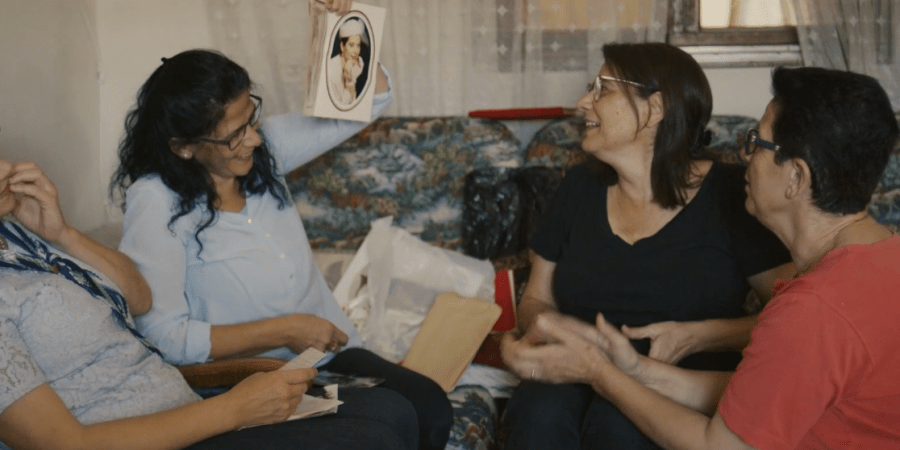
In addition to the use of archival videos, as an alternative form of storytelling Abbass often recreates key moments in her life—at times as a playful, tongue-in-cheek performance, at others signalling deep, ruminative introspection, reflecting her strong capabilities as an actress. In one scene with her sister and a former colleague at the Palestinian National Theatre, Abbass acts out the moment she told her father she was getting married to an Englishman. Off-screen, Lina calls out directions. She asks her mother to turn to the side, and coaxes her to dig deeper. Abbass, near tears, breaks character and says frustratedly, “What are you after, Lina?” Sharp feelings like this stand out amongst hazy and dream-like recollections, like a piercing light.
The dual experiences of migration and forced exile are nonlinear and messy, and the desire to be free of borders while still maintaining tradition is a present and recurring paradox for Abbass. Switching rapidly from the past to the present at seemingly random moments, the film also demonstrates how different timelines coexist through the scattered and shared memories of each person, even if their stories are fragmented.
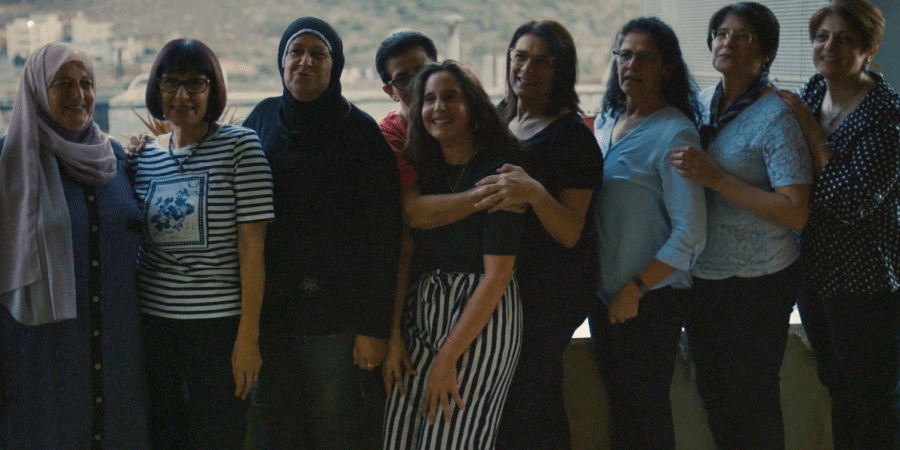
Watching Bye Bye Tiberias during a time when Palestinian people continue to be violently oppressed and displaced, I am reminded of the much-quoted line by Robert Penn Warren, who described the specificity of being “a bubble on the tide of empire.” In many stories, the personal is overridden by the historical; people are turned into numbers, faceless bodies, or statistics. Yet, this film demonstrates how collective memory is made up of individual stories that we must keep alive. What does it mean to bear witness as a deliberate and engaged act? I am thinking of the women collapsing into laughter as they line up for a family photo in Nemat’s house, the painful footage of Abbass’ second marriage to Soualem’s father, her glassy eyes in the midst of a crowd. I linger on the reunion between Abbass and her aunt Hosnieh, who migrated to Syria after being exiled, how she cried for the “scent of family” as she clung to her niece in a tight embrace. “Behind our smiles, I know the fear that sleeps within us,” Soualem narrates towards the end of the film, when the family is seen together again. “What if the remains of this place were to disappear?”
At a time like this, this question is imminent and confronting. In many ways, Bye Bye Tiberias provides a speculative future to hope for, where joy and kinship are stronger than the violence that has been inflicted for over a century. By interrogating the personal, historical, and visual legacies she has inherited, Soualem draws out a memorable portrait of exile, rearranging abstract and complex feelings that have real and material consequences. It is a story about the strength of Palestinian women and the necessity of transmitting memory, even if this includes “past sorrows,” knowing that this is not in opposition to humour, care, and love. It is about knowing that the silence and the noise coexist all at once.
Bye Bye Tiberias is screening in Melbourne on Sunday, the 17th of March, as part of this year’s Palestinian Film Festival.
**********
Donnalyn Xu is a writer, poet, and arts worker living and learning on Darug land. She is interested in the entanglement between art and language, particularly as a shared mode of enquiry and care. Her work has been published in Voiceworks, Peril, Cordite, and elsewhere.
 Rough Cut