


In the work of Japanese director Junta Yamaguchi, two minutes is a significant parcel of time. In his first film, Beyond the Infinite Two Minutes (2020), a café owner and his friends discover a TV that can see two minutes into the future. In Yamaguchi’s follow-up, River, he wreaks further temporal havoc; at a traditional Kibune inn in wintry Kyoto, workers and guests find themselves caught in a sudden, unexplained time loop which, instead of repeating an entire day, is confined to a short two-minute span.
In the director’s films, both low in budget and high in concept, this brief window is enough time to get close to something, to ask a question, to experience something new. But it is rarely enough time to reach beyond the immediate moment, let alone solve a problem. For viewers, this is bound to produce a feeling of constant fragmentation well-suited to our digital moment. But while the characters in River might check Twitter for clues about their metaphysical predicament, Yamaguchi’s grounded sci-fi cares less about the digital age and more about the desire to halt the bustle of modern life altogether.
The film centres on Mikoto (Riko Fujitani), a bright, friendly room attendant at the inn. River is mercifully quick to establish its concept, and once time begins repeating, Mikoto and her colleagues are equally quick to discover the abnormality. She and a clerk (Munenori Nagano) find themselves clearing a table they’ve already cleaned, repeating an earlier discussion with an unnerving sense of déjà vu. With a fade to black and low, muffled sound effect—not unlike being caught beneath a wave—the sequence resets. By the time the pair reunite, they’ve basically diagnosed the problem for what it is: a two-minute time loop, albeit one in which everyone’s memories carry over from one iteration to the next, resetting only their physical locations.
Yamaguchi shoots each version of the cycle in a single, fluid take. At the commencement of each loop, we find Mikoto looking into a river that runs adjacent to the inn—a ‘flow of time’ analogy that’s explicit, perhaps, but charmingly simple. As Mikoto, the sight of Fujitani’s face becomes an absorbing, emotive fulcrum, often performing a delayed reaction to the events of the previous loop: determined, exhausted, anxious, even smitten. By returning to the same moment and character, Yamaguchi provides a unique, intimate journey that orients the viewer both tonally and spatially. With each riverside beginning, we feel Mikoto’s fatigue as she climbs stairs and crosses buildings to re-meet her colleagues, cinematographer Kazunari Kawagoe’s handheld camera trailing eagerly behind.
River has many forebears in the time loop genre, yet when considering its absurd metaphysical obstacle, I tend to think of Luis Buñuel. Specifically, The Exterminating Angel (1962), where guests at a dinner party are trapped together in a single room, unable to cross an invisible boundary to leave. Or The Discreet Charm of the Bourgeoisie (1972), in which a wealthy group of friends are repeatedly thwarted in their attempts to share a meal together. For Buñuel, frustration and repetition dredge up the suppressed anxieties of the bourgeois class, amplifying their neuroses and unfulfilled desires. But where the Spanish master tortured his privileged subjects, River deals primarily with service workers alienated from their time. Plates already cleaned are re-dirtied. Sake intended to be heated up always comes out cold. “We entertain our guests whatever nature throws at us,” Mikoto’s boss (Manami Honjô) insists. Even when the fabric of time is warped out of shape, tending to the clientele is still priority number one. For their customers, this raw deal enables endless indulgence: bowls of rice, depleted over the course of two minutes, are automatically replenished.
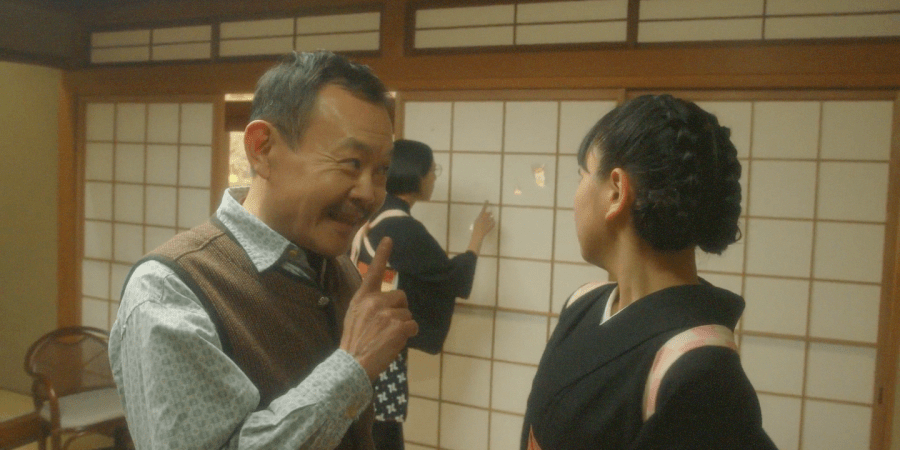
While the characters begin to experience the loop as a literalisation of their repetitive labour, it also, at times, offers a reprieve. In one sequence, Mikoto and co-worker Chino (Saori Koide) discover one of their tenants, a writer (Yoshimasa Kondô), destroying the paper partition doors of his room. He encourages the workers to poke their fingers through the tattered paper with him. “You wanna rip it?” he entices. “This is your only chance.” Mikoto is hesitant. Her job puts her in service of the inn and its façade; to tarnish it, even if the consequences will soon be reversed, is so forbidden as to be almost unthinkable. She hovers beside the partition, finger extended. A current of desire hums in her expression before time inevitably resets—a fraction of a second too soon.
In time loop cinema, characters must often seek a corrective to the past by preventing certain events, thereby saving themselves or others from an undesirable fate. Maybe they’re caught in purgatory until they learn some grand personal lesson. Yamaguchi and his screenwriter, Makoto Ueda, toy with these conventions yet wisely temper them with an earnest, screwball sensibility. The cast is incredibly game; the director’s theatre background translates well into commanding a sizeable ensemble cast (many of whom are part of the same theatre troupe, Europe Kikaku), with choreographed fights, freak-outs, slapstick, and creative blocking.
The writer experiences great relaxation when he learns his deadline won’t arrive, while his publisher (Haruki Nakagawa) runs through the inn in only a towel, risking the establishment’s image. Two friends (played by Gôta Ishida and Masashi Suwa) argue over years of unspoken bitterness. A sous chef (Yoshifumi Sakai) seems to be the only one committed to fixing the temporal spiral yet struggles to gather everyone in one place to strategise. Amidst its comedy, the existential torture implicit in River’s premise arrives in dark bursts: isolated from the central group, an unseen taxi driver crashes his car with every reset. Meanwhile, a lonely hunter believes that he alone is being cosmically punished. These coinciding narratives occur mostly offscreen, momentarily intersecting with Mikoto’s path before diverging again.
Nestled within such tight plotting, River manages to make time for romance. Partway through the film, we learn that Mikoto has made a prayer to a god of love to stop one of her co-workers, a budding chef named Taku (Yûki Torigoe), from moving away. Perhaps, she confides to Taku, her prayer is the reason for the temporal mishap. Instead of degenerating into further conflict, the pair spend several snowy loops together as fugitives, trying to outrun time and the other characters. In multiple escape attempts—imbued with a warm irreverence reminiscent of a classic 60s charmer like Charade (1963)—Mikoto and Taku search for places to hide together, even if only until the cycle resets.
By film’s end, the early strands of service industry critique have largely fallen to the wayside. In their place, however, is the kind of twist that reminds one how joyously absurd a good sci-fi premise can be. At one point, each character begins to think their anxiety about the future has caused the loop, as they all yearn for pause and connection to stave off the inevitable. River’s conclusion joins the dispersed group together to soothe their predicament in a sweet, sincere ode to community. Yamaguchi and Ueda tie a bow on their narrative without insisting on any earth-shattering conclusions; if life’s flux sometimes seems too much to bear, it comes as no surprise that we need one another’s support and grace to move onwards.
River screened in February as part of Obsessions: A Static Vision Festival.
**********
Tiia Kelly is a film and culture critic, essayist, and the Commissioning Editor for Rough Cut. She is based in Naarm/Melbourne.
 Rough Cut